
Intro Part 3

In this final intro, I’m going to lay out an idea of the path forward. Hopefully by now I’ve provided a rough foundation on which to construct these illustrations. It’s not possible to provide a total accounting of every element of attachment theory, emotions, conflict, or communication. That would be way too long, and probably boring as hell. I’m hoping to give you just enough of an idea so the illustrations I’ll lay out make sense. This will enable you to implement them in your own life. However, emotions and communication are incredibly difficult to master. If you feel like you need more direct help, reach out to me for actual couples therapy here.
Following the path to connection. Co-regulation is the key that unlocks better communication, less conflict, and more connection. It is the way we stop feeling this negative feeling, but in a positive, helpful way. So what is it?
The Path of Co-Regulation
My definition is two or more people collectively managing the emotions that exist in the space between them. As I’ve discussed, emotions don’t exist only within a single individual. They exist within and between individuals. They are socially created and socially managed. Likewise, the attachment system is something that exists within myself, but is also bound up together with my partner and their attachment style. We act independent of one another, but start to adapt and react to one another. It’s like driving. On a country road, I will act a certain way. In a crowded city, I must adapt and react to others.
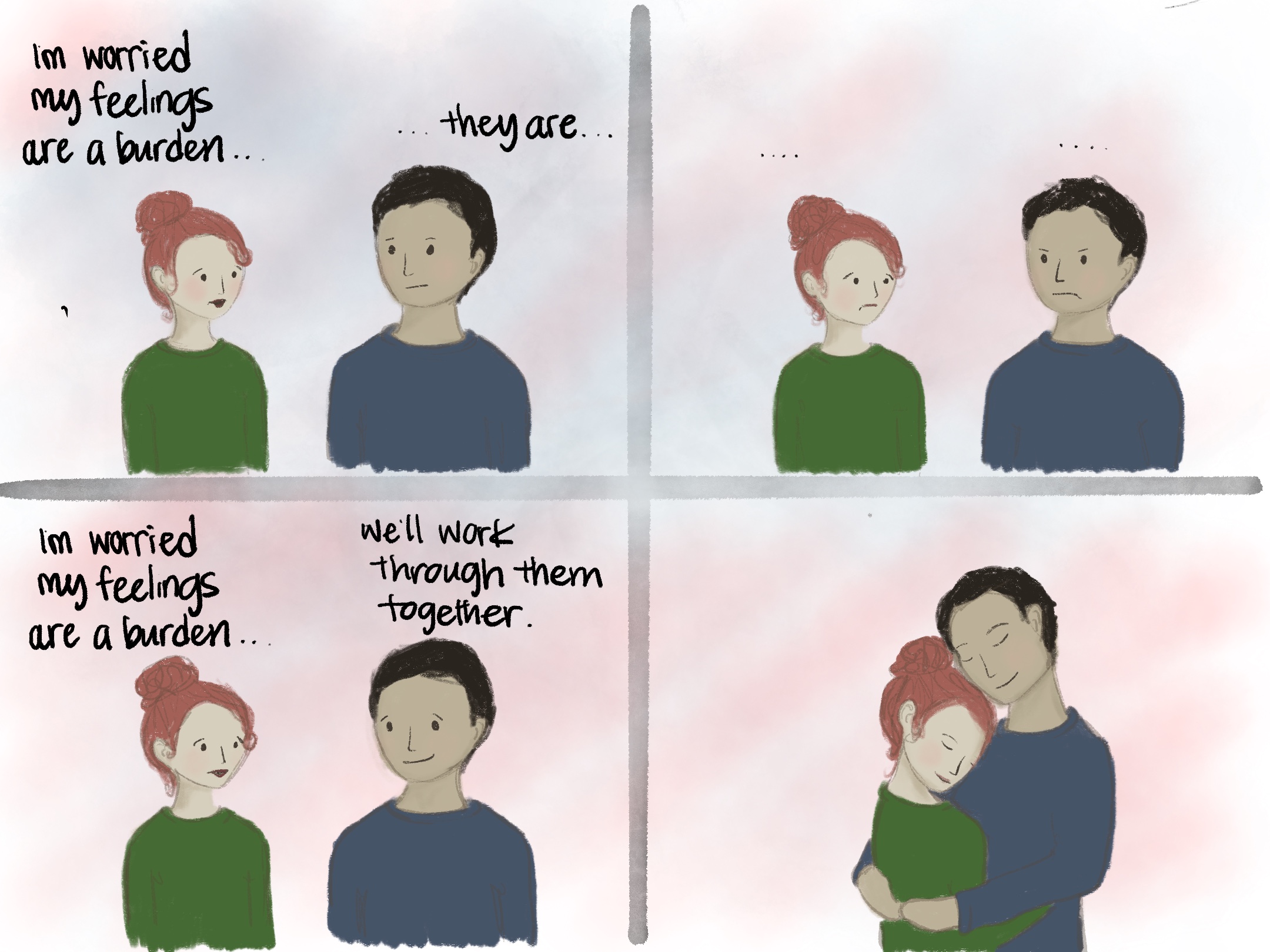
Co-regulation concerns how to manage the emotions that arise within and between us, and to remember that it is always “we” involved in that process, never just “me” or “you.” (As a quick aside, self-regulation certainly exists. I’m not trying to imply it does not. But I believe self-regulation can only develop out of an environment of co-regulation.)
This flies in the face of how most of us were taught to think about emotions. When my partner has a big emotional reaction, most of us try to “fix” whatever the issue is. We might do it through advice, trying to problem-solve, or maybe pointing out where their thinking is wrong. There are many strategies. And the truth is, none of those actions is bad in and of themselves. The problem is, fixing the emotions is almost never about actually solving the problem. It’s usually about helping my partner stop feeling their negative feelings so I can stop feeling my negative feelings. This will then lead us back to being at peace with one another. Or so we think.
Co-Regulation Makes Space For Even More Emotions
What if, instead, the goal became to make space for even more emotion? Not just yours, but also mine, and the new ones that are created from the mixture of the two? So when my partner has a big emotion, my focus shifts from how to fix it, or help, or make it better, to simply how to make space for them to be who they are. There are a thousand barriers to this approach. I might take it personally. I might have my own strong emotional reaction that I don’t want to talk about, so I try to dismiss theirs to get rid of mine. I might legitimately believe I know the way for them to feel better. Each of these barriers, and more, is what the illustrations will be about.
But the overall approach is to fundamentally change the way we think about emotions and attachment to one another. The goal is not to stop feeling negative emotions. It is to create a space where we feel secure to feel those negative feelings together. A space free from judgement, free from the anxiety to fix, free from the competition that meeting your needs means sacrificing mine. And the curious paradox is, once we work toward that goal, the negative feelings start to go away. We co-regulate. You are scared, or sad, or mad at me, or lonely. Any or all of those feelings might even be because of something I’ve done. And if I can validate those feelings and show you I’m not afraid of them, not afraid of you, the intensity starts to dissipate.

A Better Way to Be Together
This is also how we create competing narratives with those negative ones we’ve been carrying with us since childhood. If I got the message I’m too much, it sure would be helpful for someone to prove to me I’m not. If I got the message my feelings are a burden, I probably need someone to prove to me they aren’t. This is where self-regulation re-enters the picture.
I’m sure you have a lot of questions about what I’ve laid out. It’s possible you even have a number of objections — ways in which what I’ve said doesn’t make sense, or some exception that proves this approach won’t work. As I said before, this process, communication, is complicated. There is no single theory or strategy that always works. Luckily for us, our brains evolved to be agile, adaptable, and flexible. Taking this approach, and layering practical illustrations on top, should enable you to develop a way of thinking and communicating with one another that goes beyond a simple set of skills. It provides a way of being with one another that, no, will not always work. But it’ll be flexible enough that, even when it doesn’t, you can co-regulate your way back to connection.