
Therapy is time-consuming, difficult, and expensive. That’s why I created the Couples Checklist. It is relationship advice to help you navigate conflict more effectively. And when you do come to see me, it’ll help streamline the process. Most of the items on this list are not revolutionary. However, if you practice them consistently, they should help you communicate more clearly, manage your emotions more effectively, and shorten the time needed in my office.

Who is this adorable wizard, you ask? Why, this is Rupert, the cat wizard who despises boredom. He dislikes long, unnecessary preambles, if he can avoid it. If you want, you can ask him to cast a magic spell, and skip you straight ahead to the checklist. If you read it, the checklist will make a little more sense. But neither I, nor Rupert, will judge you. So go ahead, and click Rupert’s magic spell link. Presto!
What is the purpose of an emotion?
Our body wants to be at peace with our environment. When we aren’t, we experience a negative emotion, which signals action to regain peace. When we are at peace, we experience a positive emotion.
What is an emotion?
A biological process. Orientation (something has changed). Appraisal (good or bad). Arousal (what do I do?). Differentiation (Combine the first three into “emotions”). Affect & Mood (the felt experience of the first four).
What about attachment?
Attachment is a system by which I get my needs met and, as a result, am at peace with my environment. Emotions themselves are strictly biological processes, but what they mean is shaped by culture, experience, and mostly, family of origin. This is the influence of attachment. If my parents are dismissive of emotions, I’ll adjust accordingly to get my needs met, most likely becoming dismissive of my own and others’ emotions. If it’s a high conflict house, I’ll adapt, most likely adjusting by thinking lots of conflict is normal.

How does all this matter to my current relationship?
If you’re having conflict, you almost certainly have different attachment strategies. Those differing strategies result in the conflict you experience. No one is doing anything wrong (usually). Most commonly you’ll see a pursuer with a withdrawer. One way to think about this is as an external/internal conflict. The pursuer has an external model. I have distress, and the solution to that distress must come from external to me, e.g., my partner. There is something they must do to help me regulate my emotions and distress. The withdrawer has an internal model. When in distress, I will shrink into myself, over-regulate myself, and you should do the same. Put in these terms, it’s easy to see the basic dilemma at the heart of most conflicts.
This is our starting ground for the couples checklist. Thanks for sticking this out with me. Now we can get to the checklist.
☐ Objection vs. Validation
This is the very first problem you encounter in conflict. Your partner says something and you object, rather than validate. It usually sounds something like, “That’s not fair,” or “That’s not what I said,” or “That’s not what I meant.” Objection leads to more conflict, more disconnect, more distance. Objection communicates it’s not ok for you to feel the way you do.
Validation doesn’t solve your problems, but it prevents the escalation that can take over a conflict. Validation communicates that it is ok for you to feel the way you do. Spoiler alert: sometimes feelings are not accurate, but they are always valid. Validation doesn’t mean you agree with your partner’s perspective, but it acknowledges that it’s valid for them to have that perspective. Validation sounds something like, “It makes sense that you’d feel that way,” or “I can see that you’re really hurting, let’s talk more about that,” or “I can see I communicated in a hurtful way, I’m sorry, can I try to say it again in a different way?”
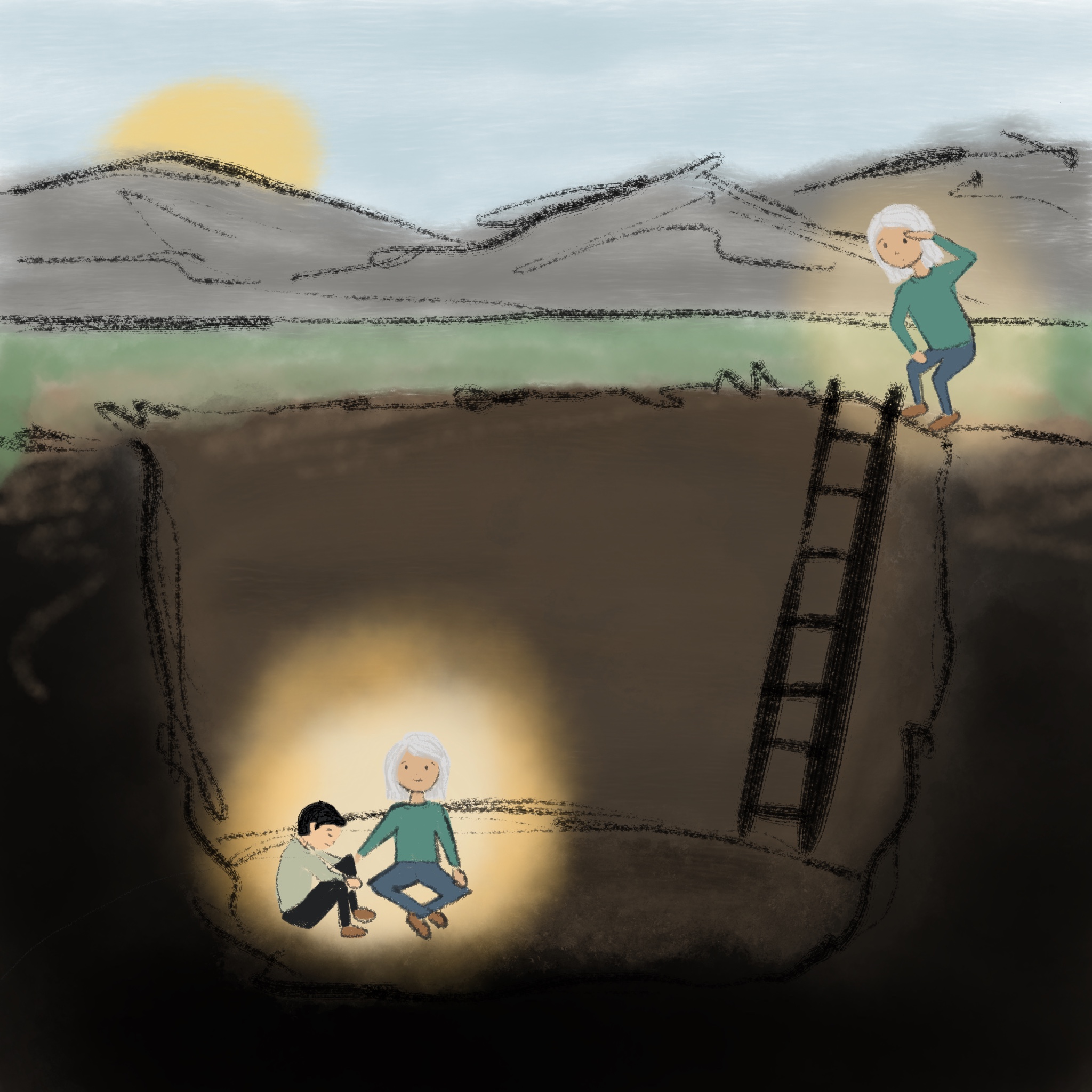
Carl Rogers said it best: When we are deeply heard, we are released from our loneliness. We have become human again. He used the analogy of a dungeon. I like to think of it as bringing light. This is what validation will do. It will drive out the lonely darkness, filling our hearts with the light of connection. Connection to your partner, the one person you are so desperate to hear you, and care.
☐ Managing My Partner’s Feelings vs. Managing My Own
This is almost always a problem. Very briefly, we have a bias toward thinking the best way toward harmony is to manage or fix my partner’s feelings. They’re upset? Let’s calm them down. They’re sad? Let’s cheer them up. There’s the positive way to manage them: let me help you stop feeling that. And there’s the negative way: you are too emotional, calm down. The problem is any effort to manage my partner’s feelings, positive or negative, will communicate that they shouldn’t be feeling that way, come off as dismissive, and lead to more conflict.
Further, you’re trying to manage your partner’s feelings as a way of managing your own. Your partner is upset? It probably makes you feel anxious. They’re sad? It makes you uncomfortable. You need to get better at letting your partner manage their own feelings, and start increasing your awareness of, and taking more ownership over, your own feelings.
☐ Protection vs. Vulnerability
This one builds on the previous two. Protection is a sort of pseudo-vulnerability. For someone like me, I can hear and see the vulnerability. For each of you, you just hear and see accusations, criticisms, defensiveness, etc. “You never listen to me!” could be something like, “I’m trying my best to communicate, and it’s not perfect, and you seem to always take it as a negative, and I get stuck feeling sad and alone.” Another example: “You shut down and abandon me,” could be something like, “I’m reaching out for you, and whatever the reason, when you pull away I feel scared and panicked I’m losing you.”
You can see how the objection/validation weaves easily into this one. “You shut down and abandon me,” is usually met with, “I’m shutting down? All you do is criticize me and tell me it’s all my fault, what am I supposed to do?” We tend to assume that vulnerability means sharing my feelings. It is that, but there’s more to it. Vulnerability also looks like sharing with my partner what they did that I found hurtful, and taking the risk that they won’t object, but respond with validation. It might be saying, “I feel sad.” It might also be saying, “You withdraw from me and that hurts.” Of course, for this to work, you need to have them read this page. So there’s that.
☐ Ruminating on the Negative vs. Ruminating on the Positive
Please don’t misunderstand. This is absolutely NOT about the power of positive thinking. This is about those of you who are frustrated, stuck, upset, and you spend the whole day ruminating on how frustrating, stuck, and upsetting your partner is. Your head is nothing but a swirl of negativity. The negativity feeds on itself, growing bigger and bigger, leading to more arguing and distance.
Ruminating on what’s good is simply setting aside five minutes to think about all the ways your partner has made an effort for you. The ways you’ve seen them grow or change, however small that might be. This is not so that you’ll forget all the negativity. Far from it. But imagine two scenarios: In the first, I spend all day in a storm of anger at how uncaring, unloving, and downright hostile my partner is. Now, go talk to them about your difficulties. In scenario two, you spend most of the day doing that, and then you set aside five minutes to think of anything they did that day that communicated they still care, that they’re trying, that they’re still a decent person. Now, go talk to them about your difficulties. In scenario two, hopefully, the conversation will take on a totally different tone, even though it’s still hard.
What now?
Well, if you don’t feel like your relationship is fixed, then by all means, reach out to me. I think this list is incredibly helpful, but as I’m sure you can tell, there’s a lot to unpack. Every relationship contains so much nuance, it’s impossible to address every concern in one article. I’m also planning to expand the checklist, to keep providing resources you can utilize on your own. I hope it’s helpful. So keep checking back.