
Intro Part 1
This is the first in a series of posts I’ve decided to call Couples Communication: A Practical Guide. A series of blog posts can’t fix your relationship, which is why I offer couples therapy. However, after ten years of this work, I’ve identified a number of skills that can improve communication in order to harness conflict to achieve closeness. And because it’s more fun, I’ll sometimes be presenting those skills with some handy illustrations.
But before I get to the actual tools, we need to lay some groundwork. These skills only work if we approach relationships, and communication within them, from a particular perspective. You will have conflict in your relationship. It is unavoidable. But there is a fork in the road, a point at which we have to decide: will we follow the negative path of discord, or the positive path of connection? Let’s get to it.
Why does conflict exist in a relationship?
Within relationships, we are all trying to create an environment that feels safe and secure. Communication breaks down and becomes conflict in two phases. First, the safety and security is threatened, and second, we each have a different plan for what will get us back to safety and security. We will start our journey at the beginning: how do we develop our ideas about what creates safety and security in relationships?

I meant it. We’re going all the way back.
When you’re first born, you are entirely dependent on someone else to care for you. The knowledge that when you cry, someone will feed you, change you, hold you, and put you to sleep is attachment theory in a nutshell. As a baby, everything feels like a threat to your survival. But you only have one mechanism to let your parents know you need them: You can cry out. It’s up to your parent to figure out what a particular cry means, meet the need of that cry, and in so doing, keep you alive. If your parents do it well (or well enough), you’ll have a secure base from which to operate in all future relationships. If they do it poorly, you’ll have an insecure base as your starting point. In an overly simplistic way, this is the difference between a secure and insecure attachment style.
It’s all about closeness.
We’re going to simplify this even further. Think about this literally. As an infant, can my parent meet my needs from far away? Of course not. You can’t change a poopy diaper from across the room. Believe me, I’ve tried. Meeting the need requires closeness. I cry out, you come close, my need is met, I feel secure. (As an aside, this raises a hugely important point: emotions are as much a social experience as they are an individual experience. I’ll get into more detail about this in part two of the intro.) From here on out, I will use closeness to describe this phenomenon. It’ll make things easier to grasp when we get into adulthood. So for now, when we talk about the attachment system, think closeness good, distance bad.

There’s one more important element to this. We develop our beliefs about ourselves and others based largely on our early attachment relationships. If our parents foster an environment leading to an insecure attachment style, it is more likely we will have negative beliefs about ourselves. Something like, “My needs aren’t met because they are too much. My parents only come close in small doses because I am too much.” Or the inverse – “As long as I don’t have any issues, our closeness remains. Disconnection happens because I’m not good enough to handle everything myself.” This takes up residence within us as a deeply felt belief. This is what most of us refer to as an “insecurity.” Insecurities are actually rooted in our very first experiences of relationships being insecure. Go figure.
Where to from here?
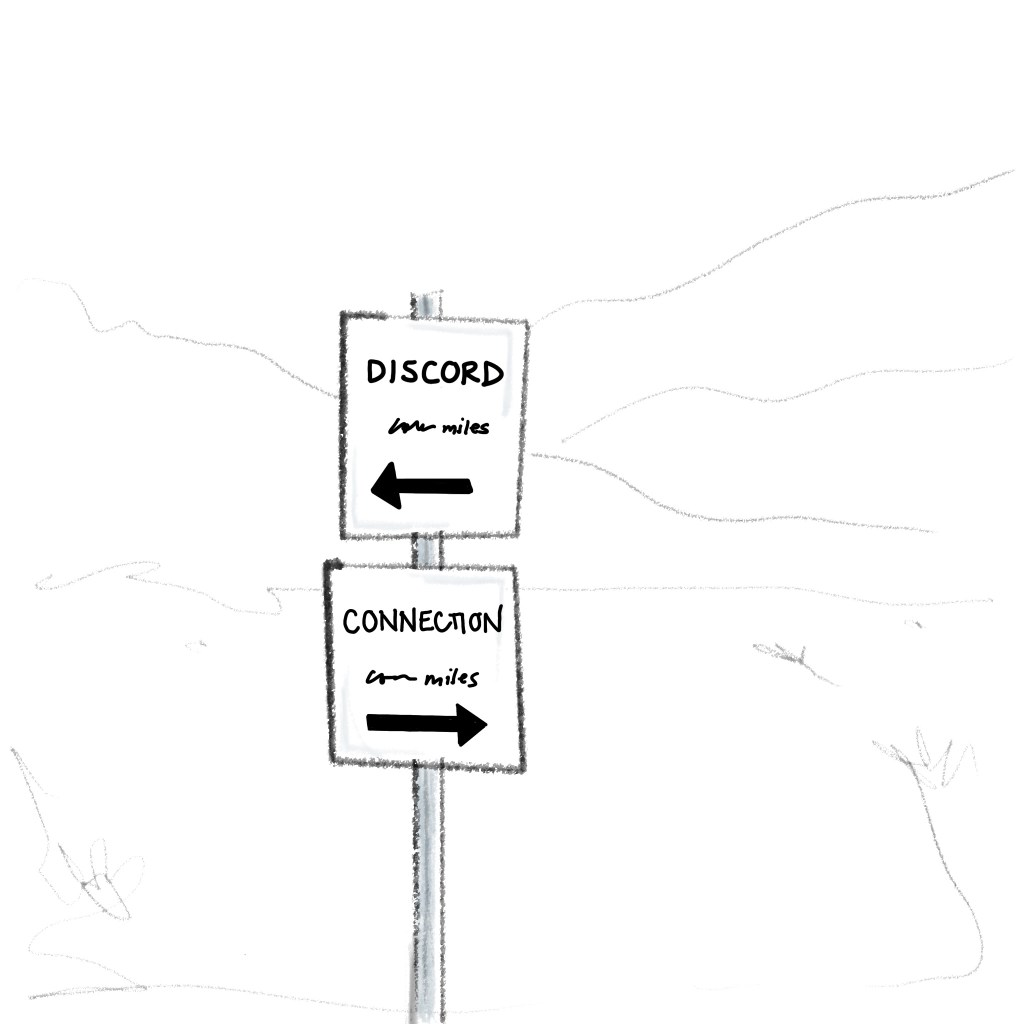
As I mentioned earlier, we are on the path of conflict. It is unavoidable. The only question is, will we follow the sign toward discord or connection? In part two, I’ll cover the path of discord. I’ll get into more depth about what emotions are and where they originate. We’ll talk about how that relates to and drives the attachment system. And then we’ll see how we end up in discord. In part three we’ll talk about co-regulation, as that is the primary method of achieving connection. Then, finally, we’ll have a solid foundation to start exploring concrete illustrations that will improve your communication and help you down the path of connection.